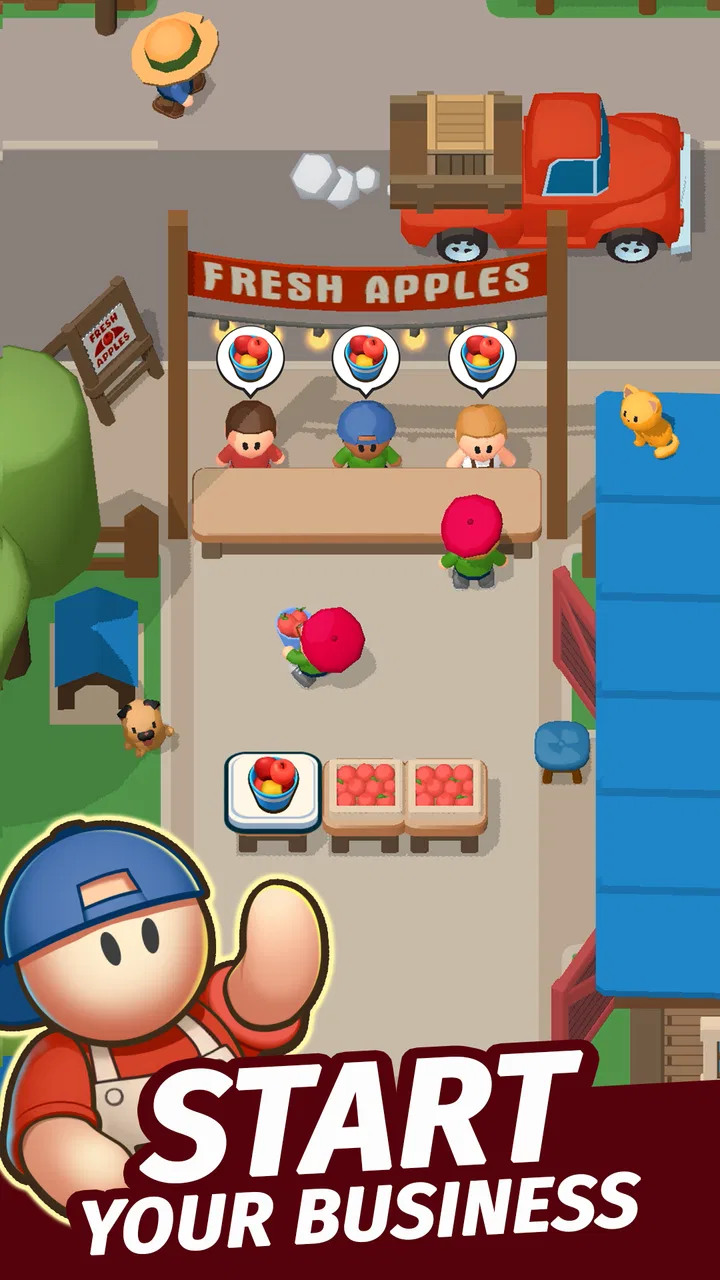
Foodventure Inc: Idle Tycoon
- 4.5
- Rating
- 5.00M
- Installs
- Free
- Price

 Analysis by App-foxy
Running a small food business sounds relaxing until every customer, upgrade, and production decision competes for attention. Foodventure Inc: Idle Tycoon turns that idea into a light simulation game from SayGames Ltd, built around preparing food and growing a restaurant operation while progress continues with relatively little constant input. I found it easiest to enjoy when I treated it as a short-session game rather than a detailed restaurant-management simulator.
The basic appeal is immediate: you open a food business, make items such as pizza and burgers, collect earnings, and improve the operation. That structure makes it approachable for players who want something simple to check during a break. It is free to start, aimed at Everyone, and available for devices running Android 8.0 or later. The game has reached over five million installs and holds a 4.5 average from around twenty-four thousand ratings, which fits its broad, casual appeal.
Getting past the first points of friction
The first thing I would tell a new player is not to rush through the opening instructions. Idle games often introduce several actions close together, and it is easy to tap through guidance before understanding which improvement affects production, earnings, or customer flow. In this game, a few minutes spent noticing what each button changes can prevent a lot of aimless upgrading later.
You May Also Like

 Blood Strike: 2.5 Anniversary
Blood Strike’s Loadouts Turn Every Drop Into a Tactical Gamble
A close look at Blood Strike’s custom loadouts: how fast access to signature weapons reshapes its battle royale rhythm, rewards preparation, and narrows the gap between fights.

 Pandora - Music & Podcasts
Pandora’s Music Is Easy to Start, but Harder to Recover
Pandora’s strength is its low-effort path from a seed to a station. Its weak spot is how much confidence it asks you to place in connection, setup, and quiet recovery.

 8 Ball Pool
 Is Built on Rivalries, Rematches, and Routine
A close look at the rivalries, rematches, shared routines, and unanswered safety questions that turn a quick pool match into a persistent mobile community.

 Samsung Music
’s Quiet Strength Is Playing What You Already Own
Its reach comes less from spectacle than from dependable access to a personal library. That simplicity is both the app’s strongest retention engine and its ceiling.

 AccuWeather: Weather Radar
AccuWeather Review: A Quick, Clear Forecast for Everyday Decisions
For everyday plans, the best forecast is the one you can understand quickly. AccuWeather makes rain timing, radar, and local conditions easy to act on, with a few trade-offs.

 Hill Climb Racing
Why Hill Climb Racing Still Turns Crashes Into One More Run
A tiny car, a bumpy hill and one more upgrade: Hill Climb Racing keeps resurfacing because its simple chaos makes every near-miss feel personal.
More From Our News Desk



A common sticking point is expecting the restaurant to behave like a hands-on cooking game. The food theme suggests chopping, timing, and assembling dishes manually, but the idle-tycoon structure places more emphasis on business progression than on precise cooking controls. If you are looking for a game where every pizza or burger requires a separate skillful action, this will probably feel too automated. If you like checking progress, choosing improvements, and watching a small operation become more efficient, the format makes more sense.
I also recommend paying attention to what the game is asking you to do before spending any available reward. Early rewards can feel generous, but using them without a plan may leave you with a temporary boost while a more useful permanent improvement remains untouched. My practical approach was to identify the slowest part of the operation first, then improve that area instead of spreading resources across every option.
The most useful early habit is to upgrade the bottleneck, not the feature that looks most exciting. If food preparation is holding everything back, improving a decorative or secondary area will not make the next few minutes feel faster. This sounds obvious, but idle games are designed to make every upgrade appear urgent.
What to check before blaming the game
Because this is a free game with optional purchases, some players will naturally wonder whether progress is possible without paying. I played it with the mindset that free progress should be the baseline, while purchases are for people who want to accelerate or personalize their experience. That is the healthier way to approach this type of game. If you dislike any game that presents paid options during progression, even when the opening download costs nothing, you may be happier with a premium simulation that has a single upfront price.
The available in-app purchases range from $0.99 to $99.99 per item. That spread is worth keeping in mind before handing the game to a child or letting someone else use your device. The Everyone content rating describes the general audience, but it does not remove the need for normal purchase controls. I would set a device-level purchase safeguard before starting, especially if the game is being used on a shared phone or tablet.
Another useful setup check is storage and system compatibility. The minimum operating system is Android 8.0, so an older device may be the first issue to investigate if installation or updating fails. On a compatible phone, I would also close demanding apps before playing if the device is short on memory. That is not a special requirement unique to this title; it is simply a sensible way to reduce interruptions in any game that loads menus, animations, and progression screens.
If the game does not open correctly, I would work through the ordinary checks in a sensible order: confirm that the device meets Android 8.0, restart the phone, make sure the installation completed properly, and try again with a stable connection. I would avoid repeatedly clearing local game data as a first response, because that can remove locally stored progress in games that do not immediately restore it. A reinstall should be a later step, not an automatic one.
Making the idle loop work for your routine
The strongest use case is a player who enjoys brief visits throughout the day. I can imagine opening the game during a commute, collecting what has accumulated, making one or two carefully chosen improvements, and closing it again. That rhythm works better than trying to force a long evening session from a game whose main pleasure comes from gradual growth.
For a more efficient routine, I would separate active play from checking in. During active play, watch which part of the restaurant is limiting progress and decide where the next investment should go. During a quick check-in, collect available earnings, review whether the same bottleneck remains, and leave rather than spending every reward immediately. This keeps the game from becoming a stream of random taps.
One non-obvious trade-off is that idle progress can make the game feel generous and passive at the same time. Returning to a larger balance is satisfying, but it can also reduce the feeling that your decisions matter if you simply accept every reward and buy whatever is highlighted. To keep the simulation engaging, I deliberately made myself choose a goal for each visit: improve speed, increase earning potential, or unlock the next meaningful stage. Even without a complex spreadsheet, that small rule adds direction.
Another practical tip is to avoid judging an upgrade immediately after buying it. Idle systems often need a little time before their effect becomes clear. I found it more useful to observe the next cycle of earnings than to tap through several purchases in succession. That makes it easier to tell whether an improvement genuinely helped or merely felt useful because it was available.
This also explains why the game may not satisfy players who want deep restaurant logistics. The focus is on accessible progression, not on writing menus, managing staff personalities, balancing ingredient inventories, or designing a dining room down to the last chair. Compared with a traditional restaurant-management game, this is lighter and faster to understand, but it gives up some of the strategic detail that makes those alternatives absorbing.
Recovering a stalled session
When progress seems to stop, I would first check whether the game is actually stalled or whether the current upgrade simply requires patience. Idle games can create the impression of a problem when the next improvement is more expensive and the current earning rate is working normally. Compare the balance before and after a short interval, then decide whether the issue is slow progression or a genuine technical interruption.
If taps appear unresponsive, menus fail to update, or the restaurant screen behaves strangely, close the game completely and reopen it. A device restart is the next reasonable step. I would also check whether the game is running on a supported version of Android and whether the phone has enough free storage for normal updates. These checks are more useful than repeatedly tapping the same control.
Network conditions can also complicate the experience. A weak connection may affect loading, store-related screens, or other parts of a free-to-play game that communicate with external services. If one screen refuses to load, I would switch between a reliable Wi-Fi connection and mobile data, then restart the game. I would not assume that a slow restaurant balance means the network is broken, though; the progression itself may simply be designed to slow between upgrades.
Be careful with recovery steps that erase information. Clearing the app's storage, changing devices, or reinstalling can be risky if progress is stored locally or if the game has not synchronized it. Before taking a destructive step, I would make sure I understand how the current installation handles saved progress. If a purchase does not appear, I would avoid buying it again immediately and instead restart the game, check the relevant screen once more, and keep the transaction information available for support.
When the phone, connection, or expectations are the real issue
Not every frustrating session points to a defect in Foodventure Inc. A phone running many background apps can make any casual game feel sluggish. An older battery or aggressive power-saving mode may interrupt background activity, which can change how an idle game feels when you return to it. A crowded notification panel, low storage, or an unstable connection can also make loading appear inconsistent.
Expectations matter just as much. The store summary presents a restaurant game involving pizza, burgers, and other food, but the experience is best understood as a progression-focused idle simulation. If you want direct control over every order, realistic cooking physics, or a competitive multiplayer restaurant, this is not the right match. A more hands-on cooking game would suit those preferences better, while a full management simulator would be preferable for players who want detailed staffing and financial decisions.
I would also skip it if you are especially sensitive to waiting between upgrades. Idle design depends on delayed rewards, and the satisfaction comes from returning to see what has accumulated. That loop is calming for some people and repetitive for others. The game is a better choice for casual players who enjoy incremental goals than for anyone seeking a campaign with a strong narrative or a fixed ending.
On the other hand, it is a good fit for someone who wants a low-pressure food-themed game that can be understood quickly. The Everyone rating makes it suitable for a broad audience in terms of content, and the short-session structure works well on a shared tablet or a personal phone. I would still supervise purchase settings for younger players because the free entry point and optional items can make spending feel like part of ordinary progression.
How it compares with familiar alternatives
Compared with a manual cooking game, this title asks less from your reflexes and more from your willingness to plan small improvements. You are not primarily trying to complete a perfect recipe under a timer; you are trying to make the restaurant earn and develop more effectively. That makes it easier to play while tired or distracted, but it also means there is less moment-to-moment mastery.
Compared with a deep tycoon game, it is more approachable but less demanding. A detailed alternative may give you more control over pricing, staffing, layouts, supply chains, and customer satisfaction. Foodventure Inc keeps the food-business fantasy while reducing the number of decisions you must track. I see that as a strength for quick sessions, not as a replacement for a serious management simulation.
Its closest appeal is to people who like watching numbers and operations improve without committing to a long uninterrupted play session. The restaurant theme gives the progression a clear identity, and the combination of active taps with idle accumulation makes it more engaging than a completely passive timer. Still, players who need constant novelty may notice the repeated rhythm sooner than fans of broader simulation games.
My practical verdict after living with the restaurant
Foodventure Inc is an easy recommendation when you want a free, approachable idle game with a food-business setting and no steep learning curve. SayGames Ltd has chosen a familiar structure and made it accessible enough for short visits. The current version is 1.0.23, and the game has been available since November 20, 2023, giving it a clear place among modern casual simulation options without pretending to be a full restaurant-management suite.
I would install it for a lunch-break game, a relaxed evening check-in, or a simple title to keep on a tablet. I would not choose it for detailed culinary creativity, serious economic strategy, or a purchase-free experience in which paid options never appear. The free starting price is inviting, but the in-app purchase range means I would configure spending safeguards before sharing the device.
My best advice is to play with a small plan: identify the slowest part of the operation, improve it, wait long enough to judge the result, and resist buying every available option just because it is highlighted. That approach exposes the game's real strength—the satisfaction of steady restaurant growth—while reducing the sense of repetitive tapping.
Overall, Foodventure Inc: Idle Tycoon works because it keeps the restaurant fantasy uncomplicated. It is not a substitute for a detailed tycoon game or a hands-on cooking challenge, but it does not need to be. For the right player, it is a comfortable, low-pressure simulation that turns a few spare minutes into a small cycle of cooking, collecting, and improving.
FAQs for Foodventure Inc: Idle Tycoon
01What is Foodventure Inc: Idle Tycoon about?
Foodventure Inc: Idle Tycoon is a casual management game where you build and expand a food business. You typically begin with a small restaurant or food stand, serve customers, earn money, and reinvest your profits into equipment, staff, recipes, and new locations. Its idle mechanics allow progress to continue with limited input, making it suitable for short sessions as well as longer play periods.
02How does the idle progression system work in Foodventure Inc: Idle Tycoon?
The game is designed around automated earnings, so your restaurants can continue generating income after you assign staff and upgrade the necessary facilities. When you return, you collect accumulated profits and use them to improve operations. Active decisions still matter because choosing which upgrades to prioritize, when to expand, and how to manage resources can significantly affect the speed of your business growth.
03Is Foodventure Inc: Idle Tycoon free to download and play?
Foodventure Inc: Idle Tycoon can generally be downloaded without an upfront purchase, but free-to-play games commonly include optional advertisements and in-app purchases. These extras may provide currency, boosts, faster progress, or other conveniences. You should review the store listing and the purchase settings on your device before playing, especially if the application will be used by children or on a shared payment account.
04Does Foodventure Inc: Idle Tycoon require an internet connection?
Some parts of Foodventure Inc: Idle Tycoon may work without a constant connection, particularly basic management and offline income collection. However, online access may be needed for advertisements, cloud synchronization, special events, updates, or verifying purchases. Because requirements can change between versions and devices, it is best to test the game after installation and check its current store description before relying on offline play.
05Is Foodventure Inc: Idle Tycoon suitable for all ages?
Foodventure Inc: Idle Tycoon is generally easy to understand because it focuses on restaurant management, upgrading businesses, and earning virtual currency rather than complex controls or difficult combat. Nevertheless, parents should check the official age rating, advertising content, and in-app purchase options before allowing younger players to install it. Gameplay may also encourage repeated sessions through rewards, timers, and progression goals.
Pros
- Simple idle mechanics make progress easy to manage.
- Restaurant upgrades create a satisfying sense of growth.
- Short play sessions suit casual mobile gaming.
- Bright visuals give the game a cheerful presentation.
- Offline earnings help maintain progress between visits.
Cons
- Progress can slow noticeably without frequent upgrades.
- Premium currency may be tempting for faster development.
- Repeated tasks can feel monotonous after extended play.
- Limited strategic depth may disappoint experienced tycoon players.
- Ads may interrupt the experience or be needed for bonuses.

Foodventure Inc: Idle Tycoon
Gallery